Sunday, November 7, 2010

Manila-Matnog v.v. in 24 hours - Man and Machine Endurance Ride (1)

As early as September, I've been following a thread in MCP Rides and Touring section titled Manila-Matnog in 24hours Extreme Ride. Last year, they had a similar feat which I missed because a few days prior to this ride, I completed my solo ride to Caramoan also in Bicol region. Needless to say, I am very much interested in joining the challenge this year.
For rides like this, careful planning is required especially for those on small bikes. Since I'll be riding my Honda Bravo for this challenge, there is really no room for mistake like getting lost. As part of the planning, I studied the maps and the start and stop points which is both located along C5.
Never been to C5 on two wheels and the mentioned places in the forums where the challenge starts and ends is really unfamiliar. Three weeks before the ride, I went to the two Petron stations along C5 where the ride is supposed to start and end.
This is the Petron station after Market-Market and this is the place where we will start the long trip at 12 midnight of November 28.
start point

And this is the Petron where we should be at before the 24 hour countdown ends.
end point

Thursday, September 30, 2010

Malabrigo Lighthouse

Malabrigo lighthouse was a surprise when I did the Lobo-Laiya loop ride.

Photobucket


Photobucket

Tuesday, September 28, 2010

Voltage Stabilizer for Motorcycles

I was lurking in MCP electrical forums and came across with a gadget called voltage stabilizer or VS.

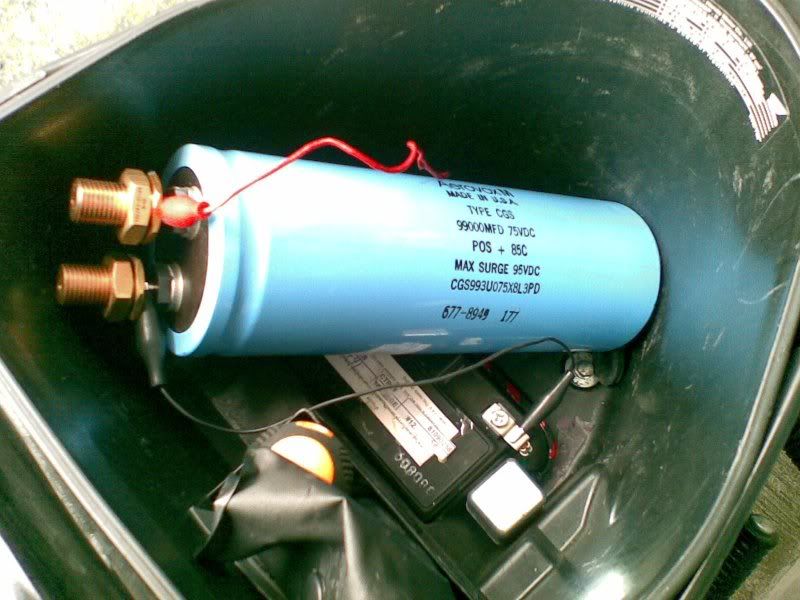
Looking into the schematic, it is nothing but capacitors and wires of course.  A variation is to put a safety feature by inserting a fuse.
Some users claim of better horn performance, easy starting and even fuel economy to mention a few of the benefits.

I tried installing my version of a VS in my motorcycle.  This is how it looks like.  It fits nicely inside the U-box.  Now I have to figure where to put my other stuffs.  Things such as spare tube, wrenches and rain gears.


Unfortunately, I didn't really have the chance to test or gather data to verify the claims above.  I prefer the peace of mind having a spare tube, tools and rain gears.  Perhaps when I can afford to buy a Givi box.

Sunday, September 26, 2010

Log Periodic Antenna (1)

The antenna motivation

Who needs an antenna when there's cable TV available?  What is log periodic and why log periodic?
complete and mounted
I live about 90 kilometers from the capital Manila and TV signals are weak.  We have two local relayed channels of the biggest TV networks, GMA7 and ABS-CBN2 broadcast on channels 12 and 10, respectively.  A simple dipole is enough to watch these two channels and that was our setup since moving here.  But then there is an emerging power in the Philippine TV network wars and it is Channel 5.  I believe the guys behind this channel is quite aggressive in designing their programming and it is also refreshing to watch an alternative.  I like channel 5 and the kids like it too which is enough reason for me to construct an antenna with a better reception.  To answer the first question, I don't think we need cable TV.  Some news and a little of those documentaries is enough for me.  The kids are happy with Ben 10, Sponge Bob, etc.  Why pay when all of these are available and free?

The log periodic antenna

So what is a log periodic antenna?  The complete name for this type of antenna is Log Periodic Dipole Antenna (LPDA) TV channels are in the so-called VHF and UHF segment of the RF spectrum and each channel has its own transmission frequency.   A dipole antenna can be optimized to receive one channel if cut according to a known formula but it won't be able to give you a good reception when you change the channel.   Since it is quite impractical to cut a dipole for each channel, a log periodic antenna is a good option.  Log periodic are wideband antennas and thus capable of receiving multiple channels.

Why part 2

Since long posts are somewhat boring,  I'll be posting another installment on the same subject.

Wednesday, September 22, 2010

Tricycles in the Fast Lane


The tricycle issue

Ask any motorcycle rider in the Philippines about their sources of frustration and grief while being on the road and tricycles will definitely be one of them.


What are tricycles

Tricycle is a common mode of public transport in the Philippines.  As the name implies, it has three wheels, two for the motorcycle that propels the whole thing and one for the sidecar attached.  Most are powered by two stroke engines due to its torque characteristics but there was a law passed that requires all motorcycle manufacturers to produce four strokes only.  I haven't read that law myself but the effect can be verified by simply observing the traffic in the Philippine roads.


Usual encounters

For the old two strokes, the power plant is usually 100cc and having said this, the tricycle is severely underpowered. It is therefore not surprising that a tricycle cruises at about 40kph.  You can imagine running at twice their cruising speed and then at a certain junction, a tricycle driver decided to join your lane, you can't help but feel bad about your helpless situation.  It could've been better if there's no traffic on the other lane which is not always the case.  I could cite more equally stressful situations but I won't because a familiar reader might get a heart attack.


Adding more power

Being underpowered is one of the problems of these tricycles.  Fortunately, manufacturers are now selling motorcycles with higher capacities like the Barako 175.  I personally saw tricycles that can cruise at about 80kph which is an acceptable highway speed.  Safety wise, I am not sure and I believe even the government don't have an answer for this.


The main problem

Another problem with the tricycle and much more potent than the lack of power is the attitude of its drivers.  I am finding it really hard to describe how these guys drive but one thing is sure, most of them drive dangerously because they are like drivers from hell.  They would turn without signaling first, accelerate and decelerate erratically, ride during the night without headlights, tail lights or both just to name a few.  If the government would be competent enough to conduct a study to find out the real root causes of accidents on the road, tricycles would be one of the top ten in the pareto.